
Columbia Track and Field Recruiting Standards
Columbia track and field recruiting is highly competitive, especially in today’s roster-limit and transfer portal environment. Meeting a published standard does not guarantee coach support or admission help. In many event groups, athletes need a combination of strong academics, event-group fit, timing within the recruiting cycle, and marks that place them above the minimum standard to become realistic supported-admission candidates. Below, we break down Columbia’s current men’s and women’s recruiting standards and explain how families should interpret them in the real recruiting landscape.
Fast Track Recruiting Founder Willy Wood spent 20 years as Head Track & Field Coach at Columbia University and nearly 30 years in NCAA Division I coaching and recruiting. That perspective matters when interpreting recruiting standards, coach support, admissions, and the real difference between a posted standard and a viable recruiting opportunity.
Columbia Track & Field Recruiting: What You Should Know
Columbia competes at the highest level of the Ivy League and consistently attracts some of the strongest academic and athletic applicants in the country. That means Columbia recruiting is far more nuanced than simply hitting a listed mark.
In evaluating prospective recruits, their coaching staff will typically consider:
Current personal bests
Rate of year-over-year progression
National and state-level competitive context
Event-specific upside
Academic strength and transcript rigor
Standardized testing (when applicable and helpful)
Positional need within the recruiting class
Likelihood of contributing at the Ivy League and NCAA level over time
The admissions component is especially significant. Even for athletes with strong marks, academic fit can be the difference between being a viable recruit and simply being interested in the school.
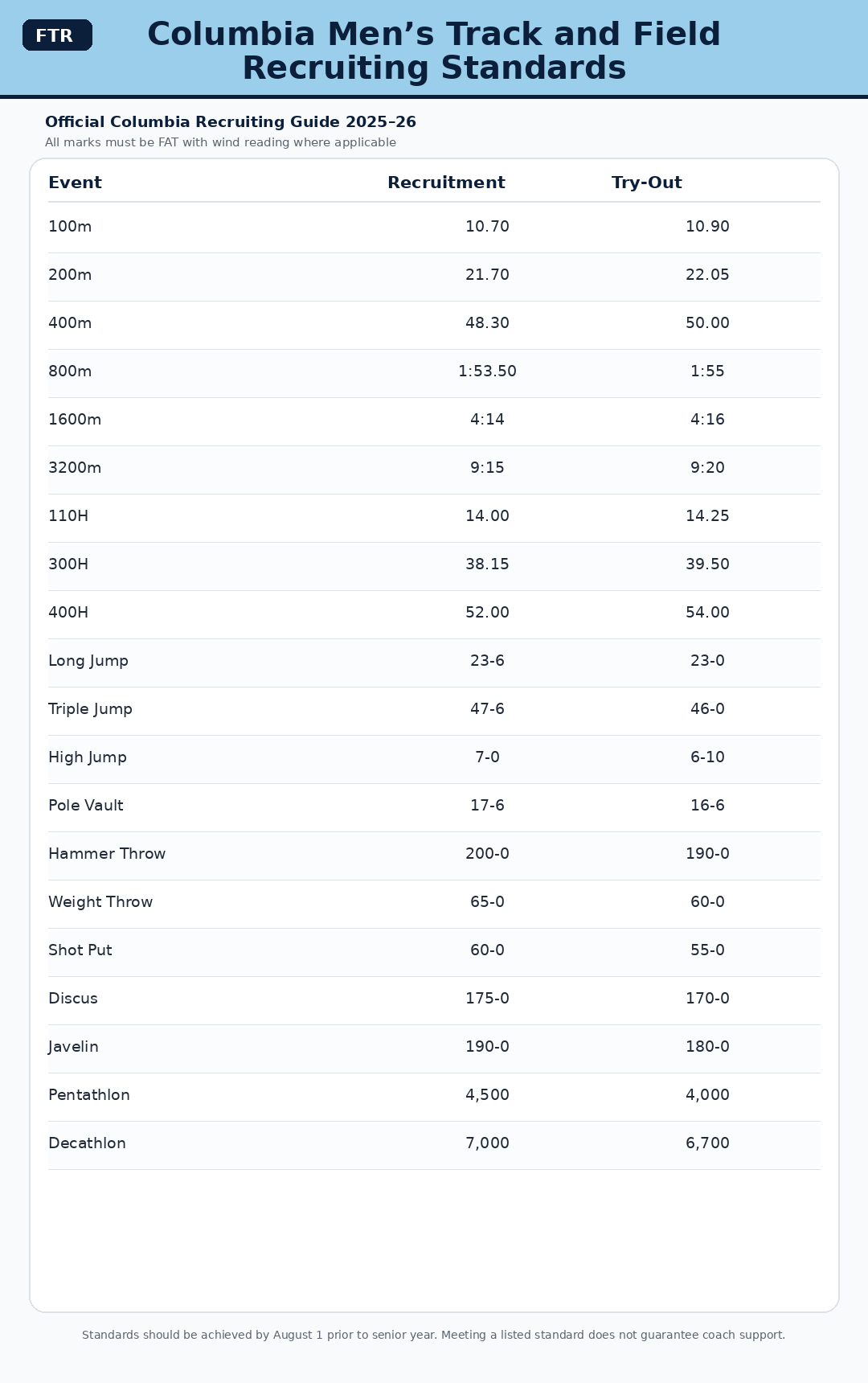
Columbia Men’s Track and Field Recruiting Standards
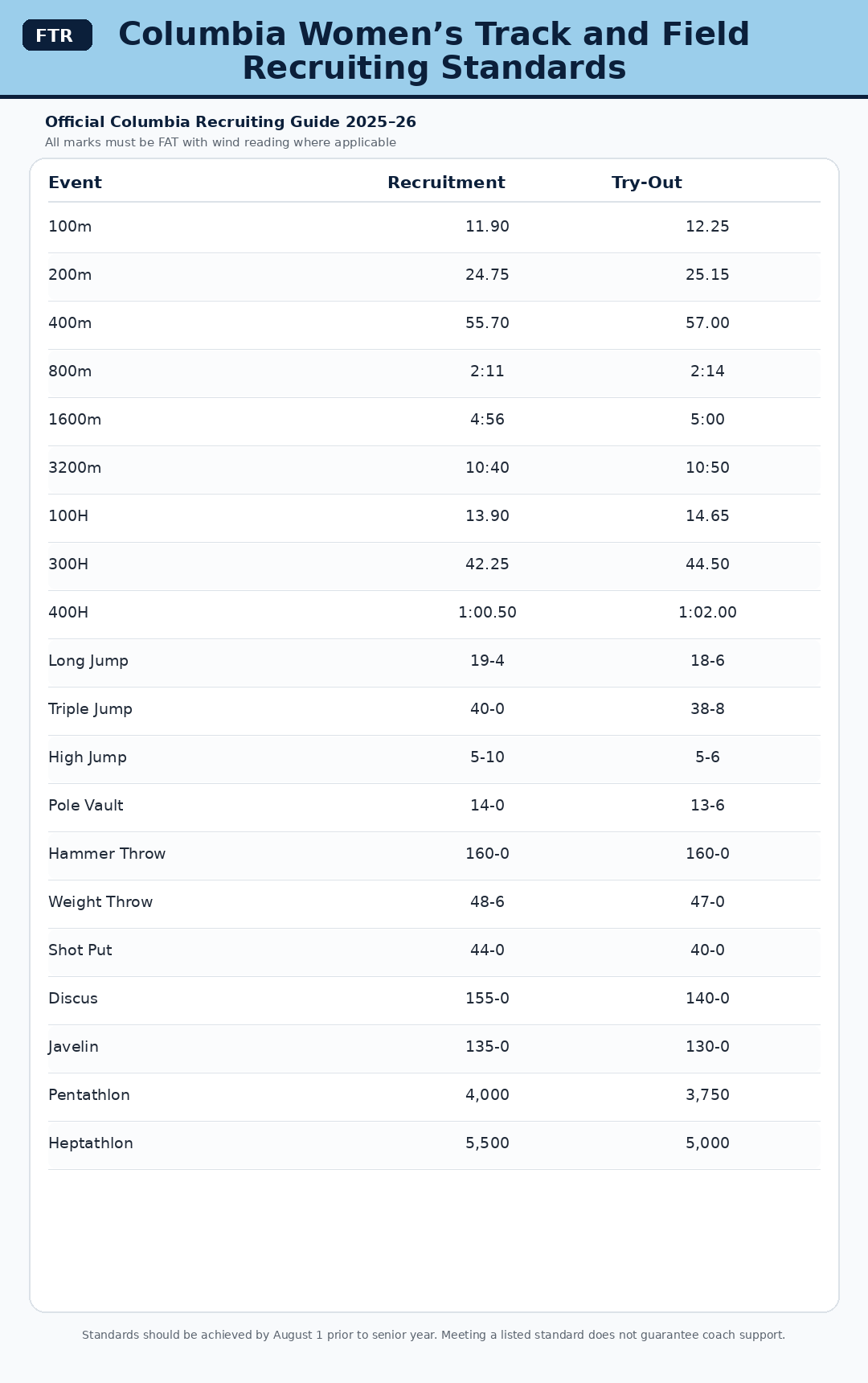
Columbia’s official 2025–26 recruiting guide includes both recruiting and tryout benchmarks, along with minimum academic standards.
Columbia Women’s Track and Field Recruiting Standards
Columbia Track and Field Minimum Academic Standards
Columbia’s 2025–26 recruiting guide also includes minimum academic benchmarks:
Unweighted GPA: 3.6 / 4.0 or 93 / 100
SAT: 1400
ACT: 33
It is important to understand that these are minimum academic standards—not “comfortable” academic standards. At a school like Columbia, stronger academics can materially improve a recruit’s position in the process and can affect how much flexibility a coach has in advocating for a prospective student-athlete.
Frequently Asked Questions
What times do you need to be recruited for Columbia track and field?
The answer depends on event, gender, and the strength of the current recruiting class. Columbia’s published standards are a useful reference point, but many serious recruits need marks that are stronger than the minimum listed standard—especially in high-demand event groups.
Does meeting Columbia’s recruiting standard guarantee coach support?
No. Hitting a listed standard does not automatically lead to coach support. Columbia coaches evaluate academic profile, event-group fit, class needs, and where a recruit stands relative to the Ivy League landscape as a whole.
What GPA and test scores matter for Columbia track recruits?
Columbia’s 2025–26 recruiting guide lists minimum academic standards of a 3.6 unweighted GPA (or 93/100), 1400 SAT, or 33 ACT. In practice, stronger academics can significantly improve a recruit’s position in the process.
Can you walk on at Columbia track and field?
Columbia’s recruiting guide includes separate tryout standards, which suggests that there may be opportunities for athletes to earn consideration outside of the traditional recruited-athlete path. But families should not assume that being near a tryout mark automatically creates a realistic roster opportunity.
How has the transfer portal changed Columbia track recruiting?
The transfer portal and roster management changes have made recruiting more selective. Even strong high school athletes now need a more strategic approach, especially in event groups where roster spots are limited or coaches may prioritize proven collegiate contributors.
What Columbia’s Recruiting Standards Actually Mean
Meeting Columbia’s listed standards does not automatically make an athlete a supported recruit. In many event groups, the real recruiting conversation depends on far more than simply hitting a published mark.
Columbia’s staff will often evaluate:
Academic profile and transcript strength
Year-over-year progression
Event-group fit and roster need
Conference scoring potential
Competitive context behind the performance
Class balance and timing within the recruiting cycle
At Brown, the standards are best viewed as a starting point — not a guarantee.
What Makes Columbia Track & Field Unique?
Columbia can be an outstanding fit for student-athletes who want a true Division I experience in New York City while competing at a high Ivy League academic and athletic level. But families often misunderstand the gap between a posted standard and true recruiting traction. In practice, coach support depends on timing, event-group priorities, academic profile, and how a recruit compares to other Ivy-level prospects in the class.
Need Help Understanding Where You Stand for Columbia?
If your marks are near Columbia’s standards — or you’re unsure whether Brown is truly realistic — we can help you interpret where you fit, how your academic profile affects the process, and which highly selective programs are genuinely in play.
Explore additional Ivy League track and field recruiting standards and recruiting insights below.
Looking at one Ivy League program in isolation can be misleading. Families often make stronger recruiting decisions when they compare multiple Ivy League programs side by side — including differences in event-group strength, academic flexibility, and realistic supported-admission ranges.
Explore additional Ivy League track and field recruiting standards and recruiting insights below:
Princeton Track and Field Recruiting Standards
Yale Track and Field Recruiting Standards
Harvard Track and Field Recruiting Standards
Dartmouth Track and Field Recruiting Standards
Brown Track and Field Recruiting Standards