
University of Michigan Track and Field Recruiting Standards
The University of Michigan is one of the premier track and field programs in the Big Ten and one of the most recognizable brands in college athletics. For serious recruits, Michigan represents a rare combination of elite athletic tradition, national-level competition, outstanding facilities, and a highly respected academic degree.
That said, Michigan recruiting is highly competitive — and simply hitting a published standard does not automatically translate into coach support, scholarship money, or a roster spot. In our experience, Michigan recruiting decisions are shaped by far more than raw marks alone. Event-group needs, roster depth, scholarship availability, timing in the recruiting cycle, competition history, and academic profile all matter.
The standards below provide a strong starting point for understanding where you may fit, but like most high-level Power 4 programs, Michigan’s process is more nuanced than a simple chart.
Fast Track Recruiting Founder Willy Wood spent 20 years as Head Track & Field Coach at Columbia University and nearly 30 years in NCAA Division I coaching and recruiting. That perspective matters when interpreting recruiting standards, coach support, admissions, and the real difference between a posted standard and a viable recruiting opportunity.
Official Michigan Recruiting Standards
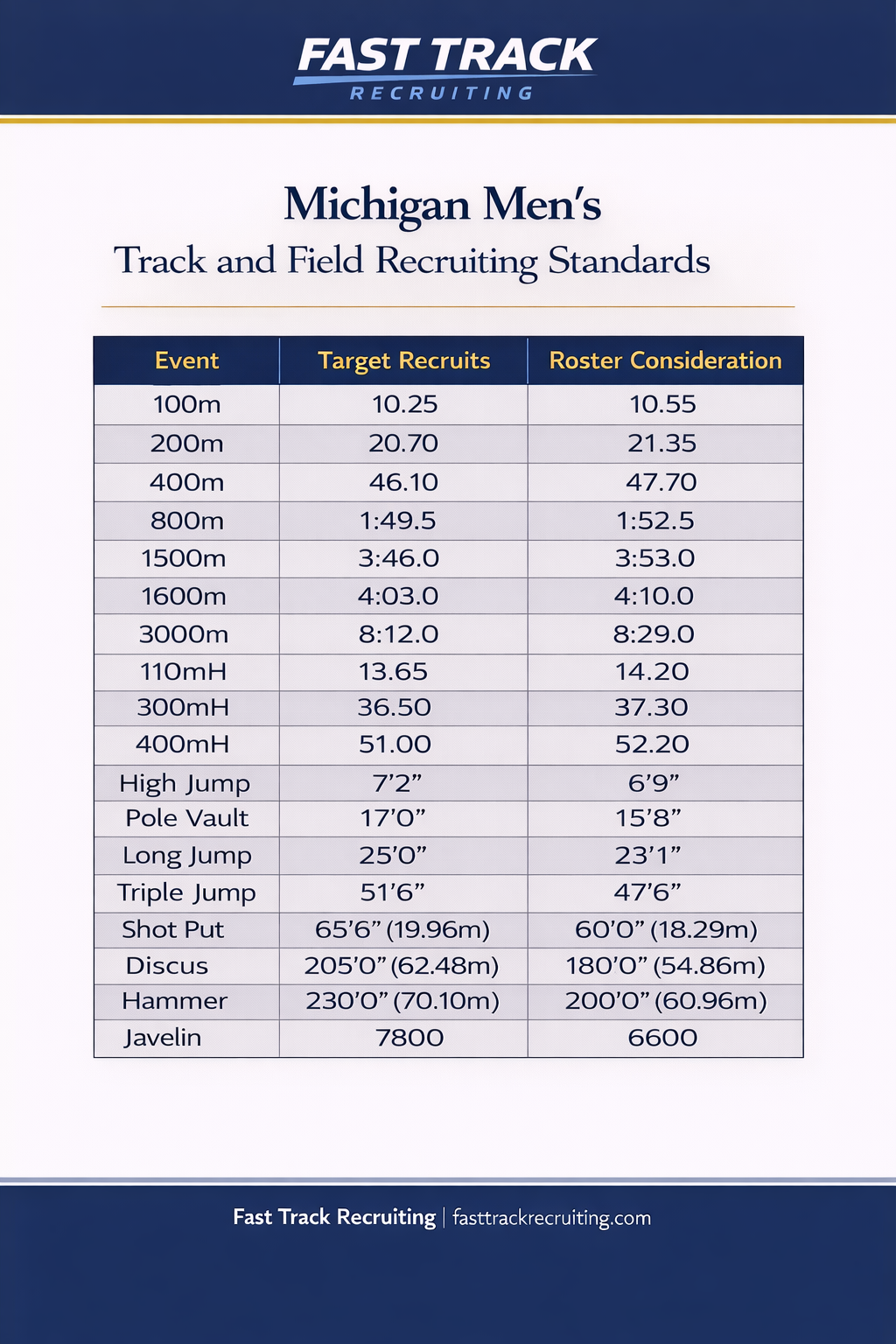
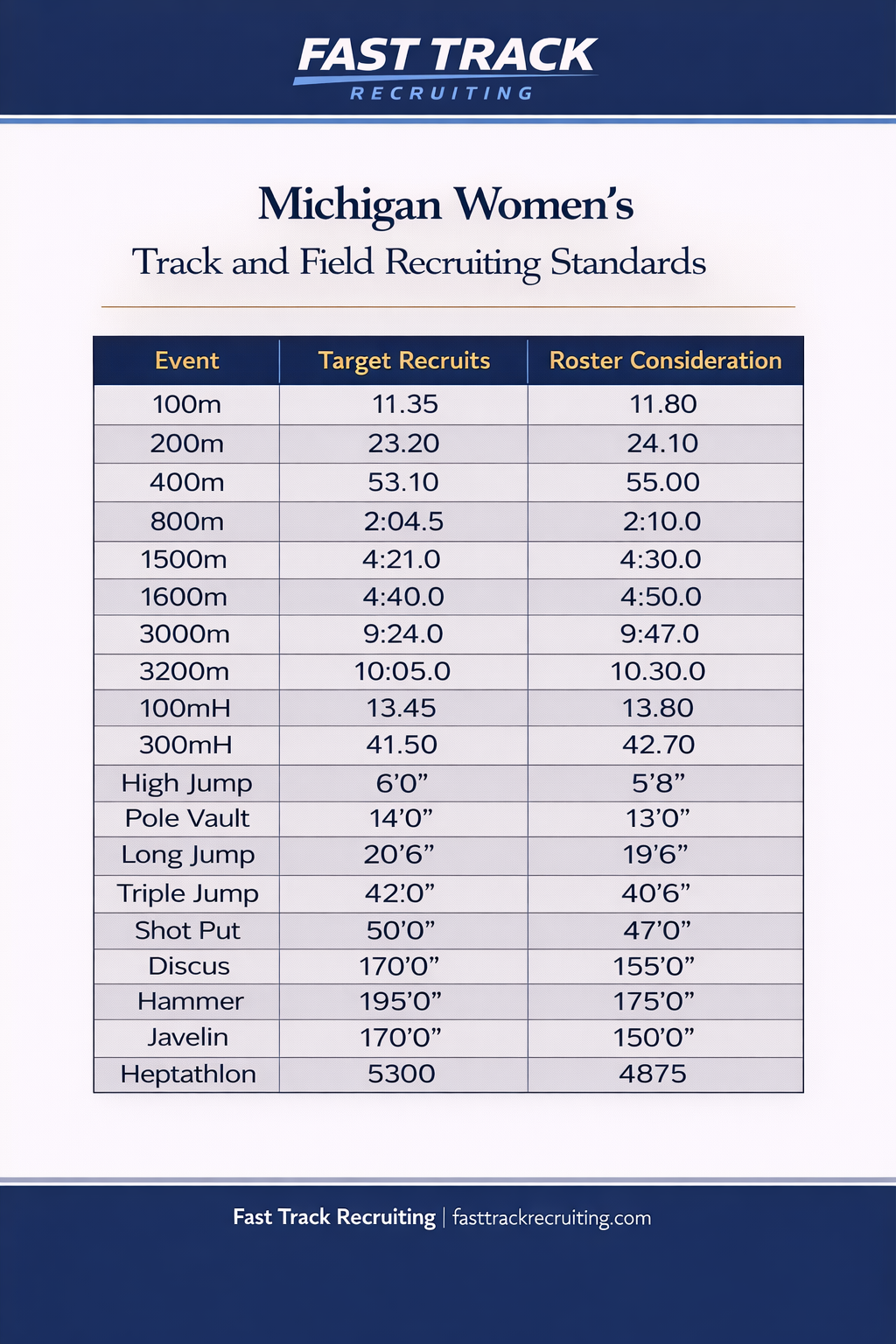
The standards below are based on the official recruiting standards published by the University of Michigan track and field program. Michigan’s own materials note that these marks are intended as guidance for recruits and coaches, are generally junior-year targets, and do not guarantee scholarships or roster positions.
Michigan Men’s Track and Field Recruiting Standards
Below are Michigan’s published men’s recruiting standards, which we recommend using as a benchmark for whether an athlete may be competitive for initial recruiting conversations and deeper evaluation.
Michigan Women’s Track and Field Recruiting Standards
Below are Michigan’s published women’s recruiting standards, which offer a strong baseline for understanding whether an athlete may be competitive for Michigan’s recruiting radar in a given event group.
As with most high-level Big Ten programs, Michigan recruiting is not purely formula-driven. A recruit who slightly exceeds a published standard is not automatically guaranteed a roster spot, while an athlete who falls just short may still draw serious interest if they fit a key event need, have exceptional upside, or bring a particularly strong academic and competitive profile.
This is one of the biggest mistakes families make in the recruiting process: assuming that “meeting the standard” means the process will take care of itself. At programs like Michigan, targeted communication, timing, coach fit, and event-group strategy are often just as important as the mark itself..
How have roster limits, the transfer portal, and older athletes changed Michigan’s recruiting?
This has changed the process significantly.
Families need to understand that the recruiting landscape is different now than it was even a few years ago.
At many strong Division I programs — including Big 10-level programs like Michigan — coaches are dealing with:
tighter roster management
less room for developmental additions
more pressure to bring in immediate-impact athletes
transfer portal movement
older and more experienced athletes in the recruiting pool
more event-group specialization
That means:
there are fewer truly open roster spots than families think
coaches can be more selective
event-group fit matters more than ever
timing matters more than ever
academics + athletic level + communication strategy all matter together
This is exactly why so many families misread a recruiting standards page.
The marks are helpful — but the real game is understanding what Michigan actually needs in your event group, in your class year, right now.
Fast Track Recruiting Insight
At Michigan, recruiting standards are best understood as a reference point — not a guarantee. A time or mark that looks competitive on paper may still fall short depending on the event group, current roster needs, scholarship allocation, and where an athlete fits within the team’s long-term priorities. We often tell families that Michigan is a program where context matters tremendously: some event groups may recruit well beyond the listed standards in a given year, while others may be more flexible if the fit is right.
For Big Ten programs like Michigan, we encourage athletes to think beyond “Can I hit the standard?” and instead ask: “Would I be a real recruiting priority in this event group, this year, for this staff?” That distinction is often the difference between getting a polite response and becoming a true recruit.
How Fast Track Recruiting Can Help
At Fast Track Recruiting, we help student-athletes and families understand where they truly fit in the college recruiting landscape.
Willy Wood, Founder of Fast Track Recruiting, spent nearly 30 years as an NCAA Division I Head Coach, including 20 years at Columbia University. That experience gives families something most recruiting services simply cannot offer: a real understanding of how Division I coaches evaluate athletes, how academic profile and event-group fit influence the process, and how to build a list that maximizes real opportunity.
We help athletes:
Determine whether Michigan is truly realistic
Identify comparable programs that may be stronger overall fits
Avoid wasting time on poor-fit outreach
Communicate more effectively with college coaches
Position academic and athletic strengths strategically
Navigate a more efficient, more informed recruiting process
The University of Michigan’s recruiting is highly competitive, and simply hitting a listed benchmark does not always tell the full story.
Need Help Understanding Where You Stand for Michigan?
If your marks are near Michigan’s published standards — or you’re unsure whether Michigan is truly realistic — we can help you understand where you fit, how your academic profile affects the process, and which Big Ten, Power 4, and elite academic programs are genuinely in play.
Elite Academic D1 / Related Recruiting Standards
Families comparing Michigan with other elite academic and Power 4 options should also review our Stanford, Duke, UNC and Ivy League track and field recruiting standards pages to better understand how roster depth, scholarship strategy, and admissions selectivity differ across top programs.
Duke Track and Field Recruiting Standards
Stanford Track and Field Recruiting Standards